.jpg&w=3840&q=75)
Today, on Maharana Pratap Jayanti, the nation remembers the indomitable spirit of one of Mewar’s greatest warriors. Yet, conventional history has done his legacy a massive disservice by framing him through the lens of noble retreat. We are taught about Haldighati, but we are kept blind to his greatest triumph: the Battle of Dewair (1582).
This was the moment a united indigenous force launched a blistering counter-offensive, proving that local kingdoms, when strategically unified, could completely obliterate the Mughal war machine. By hyper-focusing on Haldighati, mainstream narratives reduce Pratap’s legacy to one of mere survival rather than definitive military victory. To understand his true genius, one must look six years after Haldighati—to the staggering triumph at Dewair.
The Haldighati Distortion: Survival vs. Victory
Mainstream historical narratives lean into the Battle of Haldighati (1576) because it allows an empire-centric view of Indian history. But Haldighati was a tactical stalemate; Akbar failed in his primary objectives to either capture, kill, or force Maharana Pratap into submission. The real turning point that restored Mewar's sovereignty came in 1582.
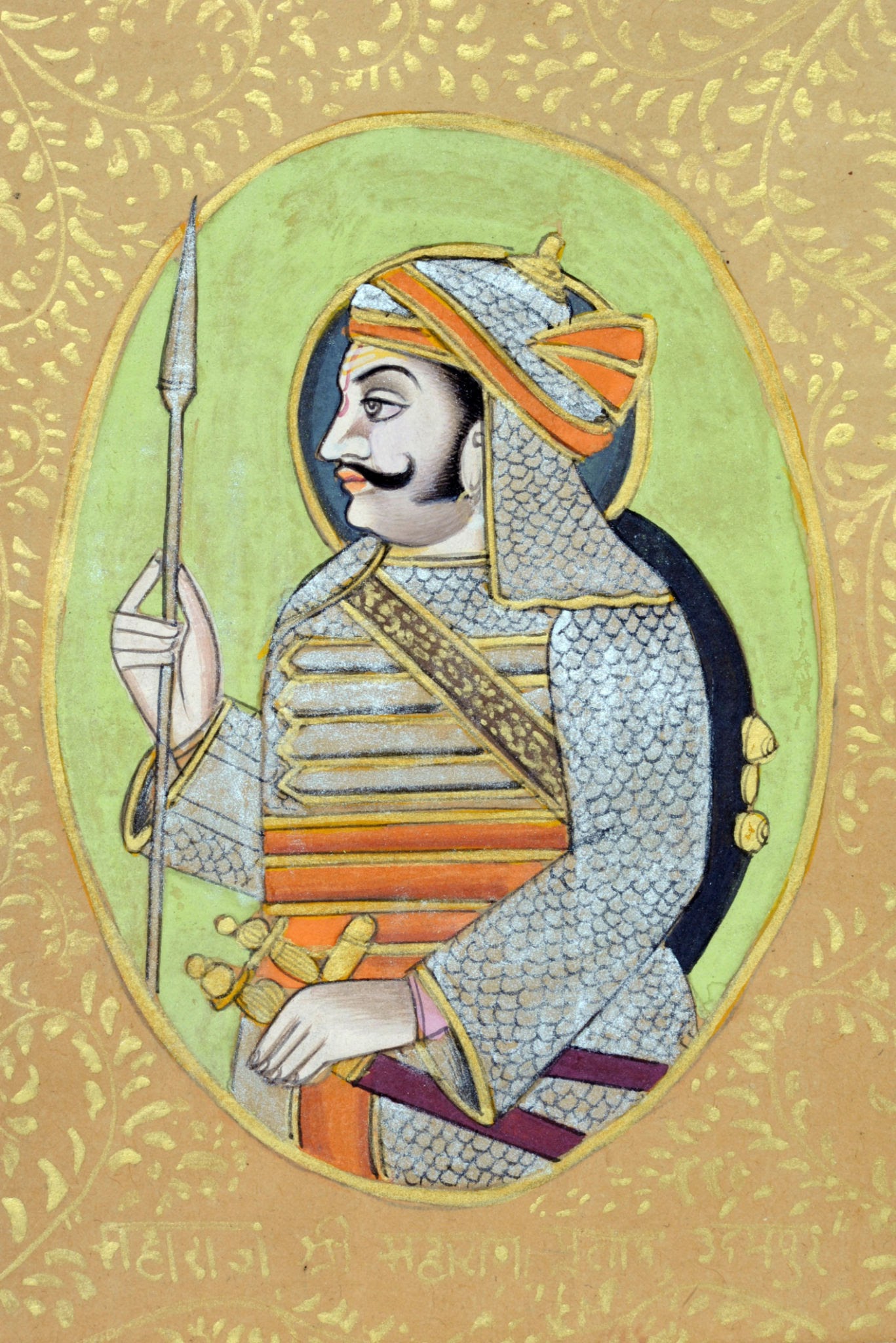
The Tactics of Obliteration: What Happened at Dewair
Following years of grueling guerrilla warfare from the hills, Pratap quietly reorganized his army. This was made possible by the legendary merchant Bhamashah, who placed his entire ancestral wealth at the Maharana’s disposal—an amount sufficient to maintain an army of 25,000 men for 12 years.
On the auspicious day of Vijayadashami in 1582, Pratap launched a coordinated blitzkrieg on the strategic Mughal military base at Dewair, which controlled the vital trade and supply routes through the Aravalli pass.
Instead of traditional open-field warfare where the Mughal artillery excelled, Pratap used the brutal mountain geography to isolate and choke the imperial garrison. He split his newly equipped army into two lethal pincers—one led by himself, the other by his son, Kunwar Amar Singh.
The climax of the battle remains one of the most staggering martial feats in Indian military history:
During the peak of the clash, Kunwar Amar Singh charged the Mughal commander, Sultan Khan, executing a spear thrust of such terrifying velocity that the weapon pierced straight through Sultan Khan's heavy armor, his body, and the torso of his horse, pinning them both dead to the ground.
Simultaneously, Mewar's forces executed a relentless assault on the reinforcing units. Demoralized by the raw ferocity of the attack and the death of their commander, the imperial forces collapsed. Nearly 36,000 Mughal troops surrendered in a single day, causing a systemic collapse of the empire's network of outposts across the region.
British historian Colonel James Tod later immortalized this battlefield in his Annals and Antiquities of Rajasthan, famously calling it the "Marathon of Mewar" —comparing it to the ancient Greek victory at Marathon that permanently halted Persian imperial expansion.
The Coalition of the Soil: How the Hindu Kings United
This wasn't just a military victory; it was a political masterstroke. After the fall of Chittorgarh, Akbar had successfully co-opted several regional rulers through political dependencies and matrimonial alliances, turning independent kingdoms into vassal states of Delhi. Pratap shattered this paradigm of submission.
He actively forged alliances with displaced Hindu chieftains, such as the Tomars of Gwalior and the Rathores of Marwar, who refused to accept imperial vassalage. More importantly, he dismantled rigid social barriers to build a seamless coalition with the indigenous forest-dwelling Bhil tribes.
Under the leadership of Rana Punja Bhil, these tribal archers became the backbone of Mewar’s intelligence network and mountain infantry. They specialized in rock-rolling ambushes and lethal hit-and-run tactics that paralyzed the heavily armored Mughal cavalry long before they could enter the valley. This grand alliance proved that true sovereignty did not rely on imperial favors but on uniting the local sons of the soil across social divides.
Conclusion: The Myth of Inevitability
Mainstream history textbooks have long pushed a subtle narrative of imperial inevitability—the false idea that local kingdoms were destined to bow to central imperial rule. Dewair completely demolishes this myth. Following this victory, Maharana Pratap went on to liberate almost the entirety of Mewar, including Kumbhalgarh, Udaipur, and Gogunda, leaving only Chittorgarh and Mandalgarh in Mughal hands by the time of his death in 1597.
